
The first day of teaching a 10-week yoga internation to KS 1 in school in Manchester, I felt both excited and curious. I began, as I often do, by asking:
“What is yoga to you?”
Their answers came instantly, and perfectly rehearsed:
“Stretching!” “Breathing!” “Flexibility!”
At the end of the session I asked:
“How do you feel?”
“Calm!” “Relaxed!” “Happy!”
It was clear that most of them had done yoga before, the kind taught from the outside in. As they spoke, I felt the tension between knowing about yoga and feeling it, about performing it and experiencing it. I thought I had been invited there to guide children to the feeling and experiencing and so, I facilitate the sessions in my style.
From Scripted to Felt
By week four, the children’s words began to shift. When I asked again how they felt after practice, the answers came slower, more honest.
“Sleepy.”
“Strong.”
“Sad.”
“Love.”
“I don’t know.”
They’d moved from performing yoga to embodying it. They were starting to name what was real, not what was expected. One boy even compared yoga to being on Mars, “my favourite planet”, and shaped his body like a spaceship, ready to take off on his journey, as if yoga was something out of this world!
That small change, from saying what they thought they should say to speaking what they felt, was the heart of emotional literacy in motion.
The Forward Fold and the Belly
One afternoon, while we were “being caterpillars,” my offering was a simple forward fold.
Some of the children, especially the ones who took dance classes, folded easily to the floor. Other were making their own version of the shape. But one girl stopped midway, touching her stomach and sighing:
“I can’t because of my belly.” looking at the bending dancers.
Her frustration was so familiar: an early, innocent form of comparison.
I told her, “Look!”, then I continued while entering the shape: I can’t go all the way forward either.”
Then we took a breath in a lifted our arms together, stretched long, and folded down slowly, stopping where it felt right.
“How does that feel?” I asked.
“My back hurts.”
“Then come back a little.”
We found her “edge”, the place between trying and surrendering. When she smiled, it wasn’t about achievement but about acceptance. I told her, “That’s the real yogi: the one who listens to their own body… and smiles at it!”
The Mandala Game
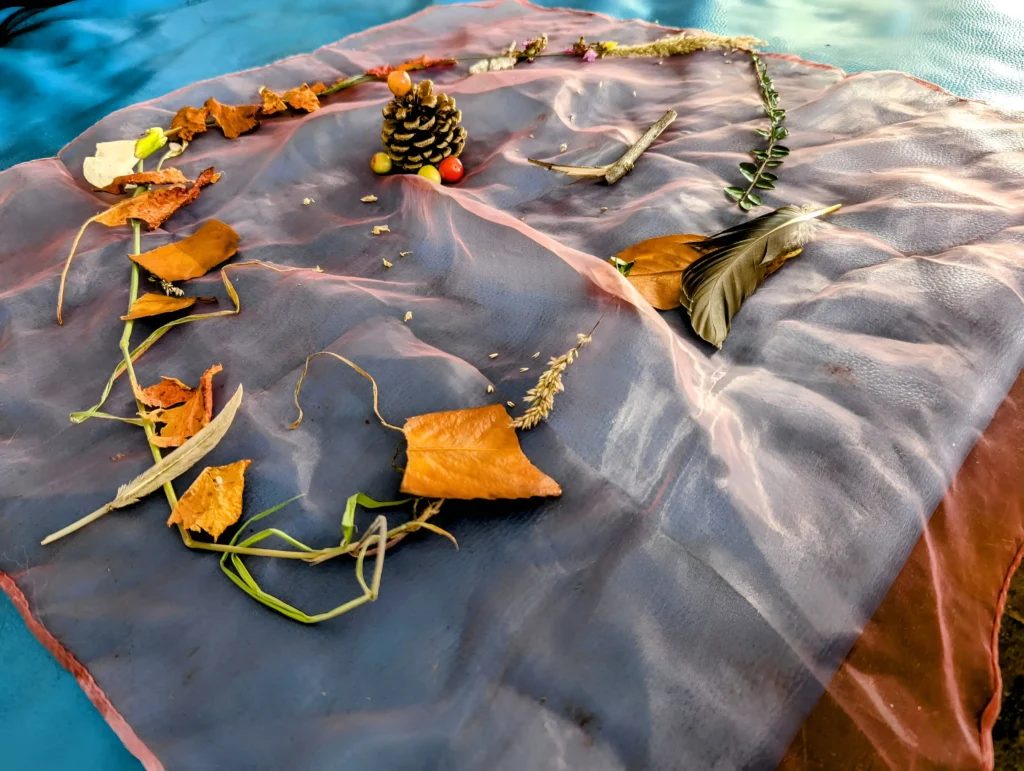
One day I brought a bag of natural objects from the nearby woods: pinecones, stones, flowers.
They were to choose to be blindfolded or to simply close their eye or look down, if they preferred. Everyone went straight for the blindfold, which was so exciting that it took ages to keep the folds up, but it was fun, and they helped each other, laughing and connecting as they did it.
Once they were settled, they each picked an object from my bag to feel, smell, and describe.
One child said, “I cannot smell.”
“Then imagine the smell,” I replied.
They laughed and started describing their imaginary scents, chocolate, rain, clouds.
After a short breathing exercise, they created mandalas with their chosen objects. Some worked alone, others together. Two girls built one collaboratively, negotiating space and design in whispers and giggles.
They were not just decorating circles; they were learning to focus, stay calm, and gently rest their attention on the materials and the moment, and to express themselves so clearly that each mandala looked different from the others. Even when children collaborated, part of the design was shared, like a frame, and another part remained uniquely theirs.
The Child Who Said, “I Don’t Love Myself.”
By the end of the ten weeks, one of the children who’d often tested boundaries had become deeply engaged in the guided relaxations, her favourite part.
One day, she turned her scarf into a blanket, inspiring others to do the same, and adding on pillows with the rest of the scarves. During our final relaxation, as I guided them through a loving-kindness meditation, she whispered,
“I don’t love myself, and I’m not kind to myself.”
It was a piercingly honest moment, the kind of truth that makes you want to pause the world. I thanked her quietly and reminded her that sometimes kindness starts by simply noticing.
That day, I realised something essential: children already know how to be mindful; they just need permission to say what they really feel.
Closing Reflection
Teaching yoga to children in the UK reminded me that yoga can easily become a script. The children arrived with ready-made words for it , “stretching”, “calm”, “relaxed”, a kind of discourse that, as Foucault suggests, shapes what we think something is before we have really felt it. At the same time, I was stepping into a system where yoga had been framed as an intervention, something to be delivered and performed, rather than a slow, lived practice.
Yet, in the room, something different was happening. As the weeks went on, the children were not just copying shapes; they were, in Piaget’s sense, actively constructing their own understanding through movement, breath, and play. A forward fold became a negotiation with a belly and with comparison. A mandala became a way to touch the world with their hands and arrange it in their own pattern. Little by little, yoga stopped being what they were meant to say about it, and became what they discovered in their own bodies.
When one child whispered, “I don’t love myself, and I’m not kind to myself,” it felt like a glimpse of what Jung might call the shadow, the parts of ourselves that usually stay hidden. In that moment, yoga was not a tool to make children quieter or more compliant; it was a space where even the most uncomfortable truths could surface and be met gently.
These sessions showed me how easily yoga and mindfulness can be turned into prescriptions, and how much more powerful they become when they are allowed to be preventative, playful, and honest. Not something to fix children, but a shared space where they can move, feel, speak, and slowly learn that their inner world is welcome.