
I do not wish them to have power over men; but over themselves.
― Mary Wollstonecraft
During my weeks at an ESOL & Drama community project, some moments really stood out for me, small, everyday interactions that revealed so much about language, culture, identity, and confidence.
From Script to Experience: Identity and Drama
During a session focused on customer service language, we worked with common telephone phrases, greetings, offers of help, and closing expressions, and practised them through paired role play.
In one role play, a participant acting as the customer service assistant answered the phone fluently and confidently, using the expected opening phrases. When the “customer” made a request, she replied politely, asked them to wait, and then placed the call on hold.
What followed was a long silence.
I asked what was happening. She looked up and said, quite matter-of-factly, “This is what happens when you call them.”
The moment shifted the exercise completely. What had begun as a language practice became a reflection on lived experience. The silence was not a language gap; it was a reproduction of a familiar interaction, waiting, being put on hold, and not knowing whether help would arrive.
Rather than correcting the role play, we stayed with it. We talked about how institutional communication often feels different depending on who is calling, and how customer-service scripts can obscure real power dynamics.
Memory, Confidence, and Creativity
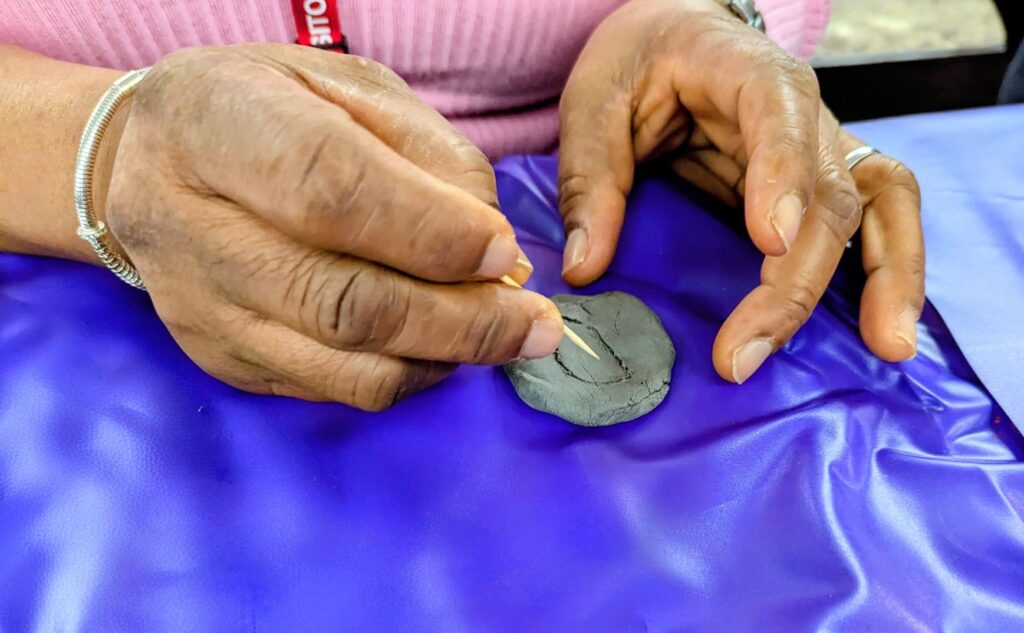
During the fossil clay activity, one participant picked a fish fossil. Instead of inventing an imaginary story, she began to share a memory from home:
“In my country, I live near the river, and I go fishing. I put a worm on the…”
She mimed the hook in the air with her hand. Her colleague next to her suggested, “Hook!”
“Yes, the hook,” she said, continuing her story. “Then I throw it in the water, and there are a lot of fish. I catch a big black fish.”
Her friend added, “It’s a catfish!”
She laughed. “Yes, the catfish! Then I go home, I prepare it, clean it, and eat it.”
It was lovely to see how the fossil had brought back this memory, and how confidently she shared it with everyone. After thanking her, I asked the group, “Is the story in the present, the past, or the future?”
“Past,” they replied.
“So,” I continued, “do we say live or…?”
“Lived,” someone answered.
“Excellent! Lived is the past of live,” I reinforced. “And what is the past of catch?”
In this way, we explored the simple past tense naturally, in action.
Despite her level of English, she took a risk to speak, using gesture, vocabulary, and grammar she already had. Half of the group went on to share stories from home, creating a rich, collaborative space for learning, memory, and creativity.
Well-being and Learning Environment
Another small but important moment came just before a session started. A participant arrived early and was making her coffee. I asked how she was, and we exchanged a few words before shifting into light conversation as others arrived.
During the session, we worked on vowel sounds, something she had asked to practise in a previous class, followed by drama and speaking activities. She was fully engaged throughout.
At the end of the session, participants added reflections to the Voices of a Tree project, writing about how they felt after the class. One reflection noted that the session had helped lift their mood.
These brief interactions showed me that this project isn’t only about language or culture; it is also about confidence, connection, and feeling part of a supportive learning space.
Closing Reflection
In this ESOL & Drama project, the small moments, the pauses, the stories, the gestures, revealed as much about learning as any planned exercise. Language was not just grammar or vocabulary; it was identity, memory, and connection in action.
By staying attentive to participants’ experiences, we allowed space for confidence, creativity, and authentic expression to emerge naturally. Learning happened through doing, sharing, and noticing, rather than through correction or instruction alone.
These sessions reminded me that education, especially in multilingual and community contexts, is as much about building relationships and trust as it is about teaching content.
*All project descriptions are anonymised and shared with consent where required. No participant-identifying information is included.